
NSD570 Teleprotection
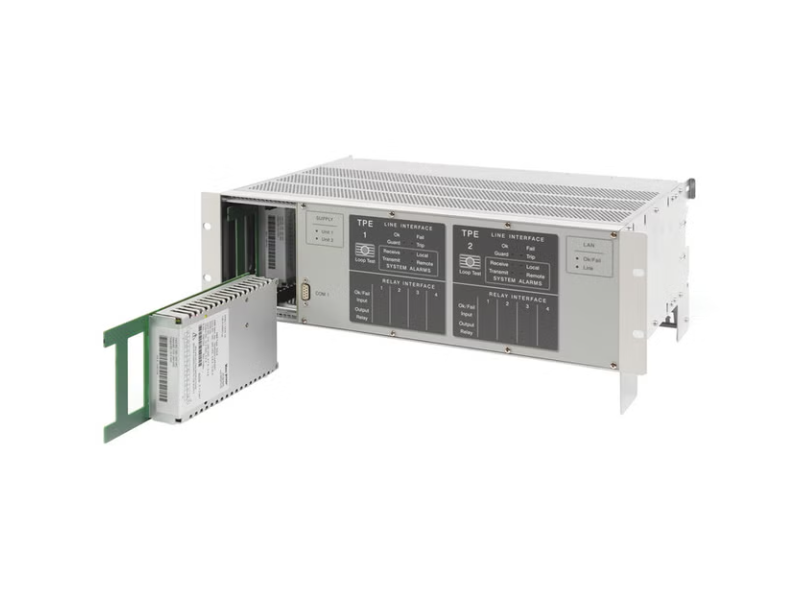
NSD570 enables the fast, reliable, and secure transmission of protection commands over any kind of communication media through a complete set of line interfaces.
It supports IEC 61850 and conventional interfaces, enabling interoperability between traditional and digital substations.
Key highlights
- Modular solution supports up to 16 commands per shelf
- Compliant with IEC 60834-1 and IEC 61850
- Supports analog, digital/optical, and Ethernet/IP-based links
- Permanent channel monitoring and advanced alarm feature


-
Product details
-
Specifications
-
Resources
-
FAQ
Overview
The NSD570 system was designed to provide simple commissioning, operation, and supervision of teleprotection links. The modular design of NSD570 provides the greatest possible flexibility and adaptability for all application requirements.
Comprehensive self-test diagnostics continuously monitor the system functionality. A serial port allows you to directly connect the NSD570 to your computer for programming and monitoring the local and remote station.
- Flexible structure with one exchangeable line interface (analog 2-/4-wire, digital G.703 or V.11/X.21/X.24, Ethernet 10/100 Mbps) and one protection interface for two commands each (up to four protection interfaces per system)
- Optional plug-on modules for digital line interface: E1/T1 interface for electrical connection to SDH/SONET multiplexer, or optical interface for direct fiber connection and optical IEEE C37.94 connection to digital multiplexers (short and long-haul SFP versions)
- Transmission of up to 8 GOOSE messages according to IEC 61850-8-1 (automated configuration of multiple substations as per IEC 61850 Ed. 2 is supported)
- Web-enabled for remote management with optional integrated LAN/Ethernet Interface
- Equipment status indicated by front panel LEDs and optional integrated LCD display
- 1+1 configuration to protect against communication path failures (only a second “standby” line interface of any type is required; no need to duplicate the protection interfaces)
- Cost-saving schemes for protection of multi-ended circuits (T-operation)
- Single or redundant power supplies
- Comprehensive set of measures against cyber/IT security attacks
Functionality
- Compact and flexible design
- Reduced inventory through modular structure
- Proven reliability in critical applications
- Advanced digital signal processing
- In-operation testing
- Easy migration between communication technologies (simply replace one module to move from analog to digital or Ethernet)
- For analog, digital/optical, and Ethernet/IP-based communication links
- 4 independent commands in analog channels
- 8 independent commands in digital/optical channels and Ethernet/IP circuits
- Individually configurable commands for blocking, permissive, or direct tripping
- Adaptive signal processing for shortest transmission times
- Fast, dependable, and secure
- Continuous channel supervision, alarm is given if channel is unavailable or has insufficient quality (e.g., if the end-to-end delay is too high)
- Integrated event recorder and trip counters
- Real Time Clock for event recording, synchronized with IRIG-B, 1PPS or NTP/SNTP
- Fully programmable by means of a browser-based Human Machine Interface (HMI), for convenient configuration, operation, and maintenance
- Remote monitoring and configuration, including Simple Network Management Protocol (SNMP) alarm traps for serving a communication Network Management System (NMS)
- HMI-integrated Element Management System (EMS) for supervising and managing the entire NSD570 network via LAN, station bus, and Embedded Operation Channel (EOC)
Use-Cases
A secure and uninterrupted supply of electricity depends on comprehensive protection and control functions to ensure reliable power system operation. As electrical grids expand and become more complex, so do the demands on the protective devices and systems that must protect them and preserve system stability.
Protection equipment, together with communication links, enables fast and selective fault isolation on high-voltage transmission lines, transformers, reactors, and other critical electrical plant assets. By enabling faulty parts to be selectively disconnected and transferring commands in the shortest possible time, teleprotection systems help prevent failure and equipment damage.

NSD570 offers a complete set of line interfaces for teleprotection across analog, digital, optical, and Ethernet/IP communications. It also supports a broad range of protection equipment interfaces to enable seamless integration.
Easy to access and to manage
The browser-based Human Machine Interface (HMI) allows easy configuration, operation and monitoring of the system. The HMI application program and a small Web server (HMI570 user interface) are quickly installed on your PC. Self-explaining menus of HMI570 make it possible to set up and operate your system within the shortest possible time.
Access NSD570 the way that fits you best, e.g. via Intranet, World Wide Web, local PC or integrated LCD front panel display.
Direct access from your PC to the equipment is possible via the serial port on the front, or via the optional LAN port at the back.
For local access to the equipment via an Ethernet port or for remote access via the Intranet/Internet, an optional Management interface can be used. It supports SNMP and VLAN ID & priority settings. To secure this management access, enhanced encryption/authentication features and user activity logging are provided. Individual accounts can be set up, with different access rights assigned to the registered users.
In a substation, several NSD570 can be connected to a local station bus (RS-485). Connection to the Intranet/ Internet is provided by a single Management interface. In such a network, all NSD570s are accessible with a unique device address. A connection to the equipment, either local or remote, is always secured by means of a user log-in with a three-level password identification (admin, modify or view access rights).
Local alarm polling in a substation and polling the alarms of an entire NSD570 network in several substations is standard function of the HMI570, an extra Network Management System (NMS) is therefore not required. The alarms of all accessible NSD570 units are polled by an HMI570 in a control center, for example, and can be displayed on a single screen.
Of course, the integrated SNMP agent can also serve higher level NMS programs with alarm and equipment information.
Hardware

- Power supply – single or dual (redundant)
- Analog line interface
- Digital line interface (with optional optical or E1/T1 extension)
- Ethernet line interface
- Protection interface (contact type and/or GOOSE type)
- Management interface (optional)
- Display panel (optional)
- Wiring directly to connectors at the back or to terminals of optional connecting cables
- Up to 4 independent commands (simultaneous, in any combination)
- Each command configurable for blocking, permissive or direct tripping
- Programmable bandwidth: from 120Hz to 2800 Hz
- Programmable centre frequencies: from 360 Hz to 3900 Hz in 60 Hz steps
- EOC (embedded operation channel) for remote monitoring and configuration
- 4-wire or 2-wire circuit, full duplex operation
- High dynamic range and wide setting range for Tx/Rx levels
- Command signal power boosting
- Up to 8 independent commands (simultaneous, in any combination)
- Each command configurable for blocking, permissive, or direct tripping
- Programmable data interfaces and data signaling rate
- EOC for remote monitoring and configuration
- Set of serial data interfaces (G.703 codirectional or V.11/X.21/X.24)
- Optional integrated E1/T1 interface or optical interface (IEEE C37.94 or direct fiber)
- Terminal addressing to protect against channel crossovers in switched or routed networks
- Electrically isolated contact type command input/output circuits
- Two command inputs and four command/alarm outputs per module
- Up to four protection interfaces per NSD570 system in the rack
- Nominal tripping voltage range: from 24 VDC to 250 VDC
- Commands can individually be mapped on any input and output
- Alarms and special functions are freely assignable to the outputs (e.g., unblocking)
- Single-pole or double-pole tripping
- Up to 8 independent commands (simultaneous, in any combination)
- Each command configurable for blocking, permissive, or direct tripping
- Programmable data interfaces and data signaling rate
- EOC for remote monitoring and configuration
- Electrical interface (10/100Base-TX) and optional optical interface (SFP)
- Proven IT/security mechanisms (e.g. only traffic from authenticated sources accepted)
- IP Address, UDP port and priority settings, VLAN support
- Up to 8 GOOSE messages according to IEC 61850-8-1, exchanged with the same protection equipment or with several devices
- Commands are transferred to the remote station via a “proxy gateway” (choice of analog/digital/optical/Ethernet line interface)
- One protection interface per NSD570 system in the rack, contact type protection interface(s) can be used in parallel (to transfer traditional commands or to signal alarms)
- Support of automated engineering processes, based on substation configuration description (SCD files), compliant to IEC 61850 Ed. 1 or Ed. 2 (HMI-configurable)
- Command value and - if required - its quality can be transferred (Logical Nodes: GGIO, PSCH, RBRF, ITPC).
- Electrical interface (10/100Base-TX) and optional optical interface (SFP)
- VLAN support


Get Guidance From Our Experts
Whether you're exploring our solutions or evaluating your next steps, our team is here to help. Speak with specialists who understand your challenges, provide clarity, and guide you toward the right fit for your operations.